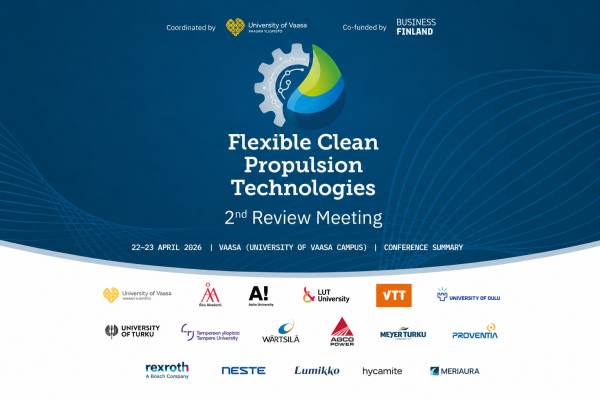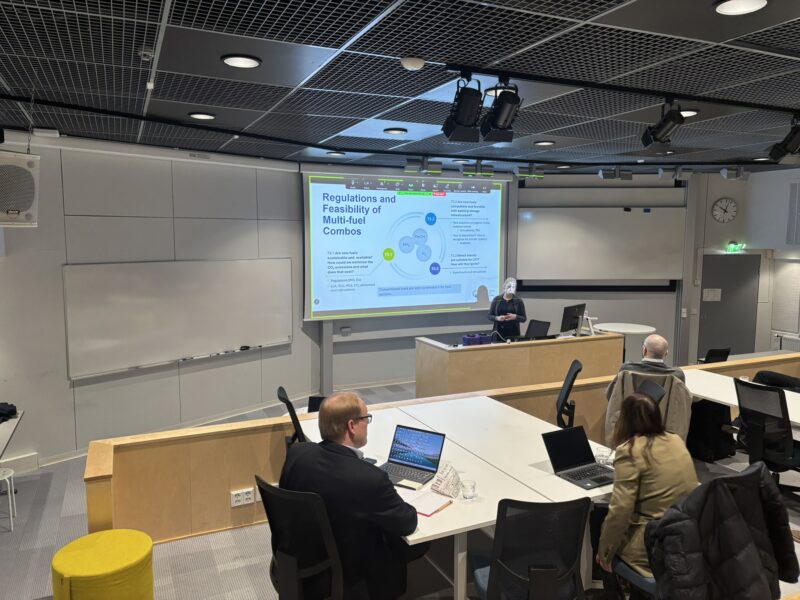
A Life Cycle Assessment (LCA) and sustainability workshop was held in Tampere on Tuesday, 9 December, bringing together researchers and industry partners from across Flexible Clean Propulsion Technologies (Flex-CPT) project consortium. The event was organised collaboratively by the University of Oulu, the University of Vaasa, and Åbo Akademi University, with strong support from Tampere University. The workshop also marked a concrete step in international collaboration, as researchers from the Hi-EFECTS project and the World Maritime University participated in the program.
Life cycle assessment has become a key method for quantifying environmental impacts across entire product life cycles, and within Flex-CPT this work is carried out under Work Package 3, Regulations and Feasibility of Multi-fuel Combinations, led by Katriina Sirviö. WP3 focuses on assessing the feasibility and usability of alternative fuels in marine and non-road engine applications, covering new zero-carbon fuel options such as hydrogen and ammonia, alongside more mature low-carbon alternatives including methane, methanol, ethanol, and bio- and renewable diesels .
One of the central objectives of WP3 is to establish a unified LCA methodology for evaluating the life-cycle impacts of new fuels and to analyse CO₂ abatement costs across different fuel options. This work is carried out under task T3.1.2, Harmonizing LCA for Flex-CPT Consortium, which has resulted in the development of a dedicated document titled LCA guidelines. The guidelines describe essential steps and methodologies of LCA research, outline current applications and limitations, and present a unified approach aligned with ongoing regulatory developments. By doing so, they aim to ensure that environmental impacts and emission-reduction costs are assessed in a comparable and transparent way across the consortium .
The Tampere workshop served as a key training opportunity for consortium members, both from academia and industry, to become familiar with this unified methodology. Professor Magnus Hellström from Åbo Akademi University presented the LCA guidelines and discussed their practical use for Flex-CPT partners. As highlighted during the event, developing a shared understanding of what LCA can and cannot deliver, and applying it consistently, is essential for meaningful comparison and discussion of different fuel technologies.
Beyond immediate project needs, the adoption of a common LCA framework also supports education. With the guidelines in place, universities within the consortium are now able to educate students using a unified approach. This benefits industrial partners as well, as future employees will enter the workforce with a consistent understanding of alternative-fuel LCAs and their interpretation.
The LCA guidelines were prepared through close collaboration between researchers in WP3, involving Magnus Hellström, David Thomas, Anthony Katumwesigye, Ramtin Heydarian, and Mika Huuhtanen. The workshop fulfilled project milestone 3.1.3, and the guidelines constitute deliverable 3.1.3 of the Flex-CPT project.
In addition to the guideline presentation, the workshop programme included several research contributions. Participants heard about differences between life cycle assessment and multicriteria analysis, and the use of the latter in a forest machinery case study, presented by Nelly Mollehuara Canales from the University of Oulu. Anthony Katumwesigye presented key findings from his LCA study on construction machinery, while Ramtin Heydarian shared his research on the impacts of alternative fuels on cruise shipping routes.
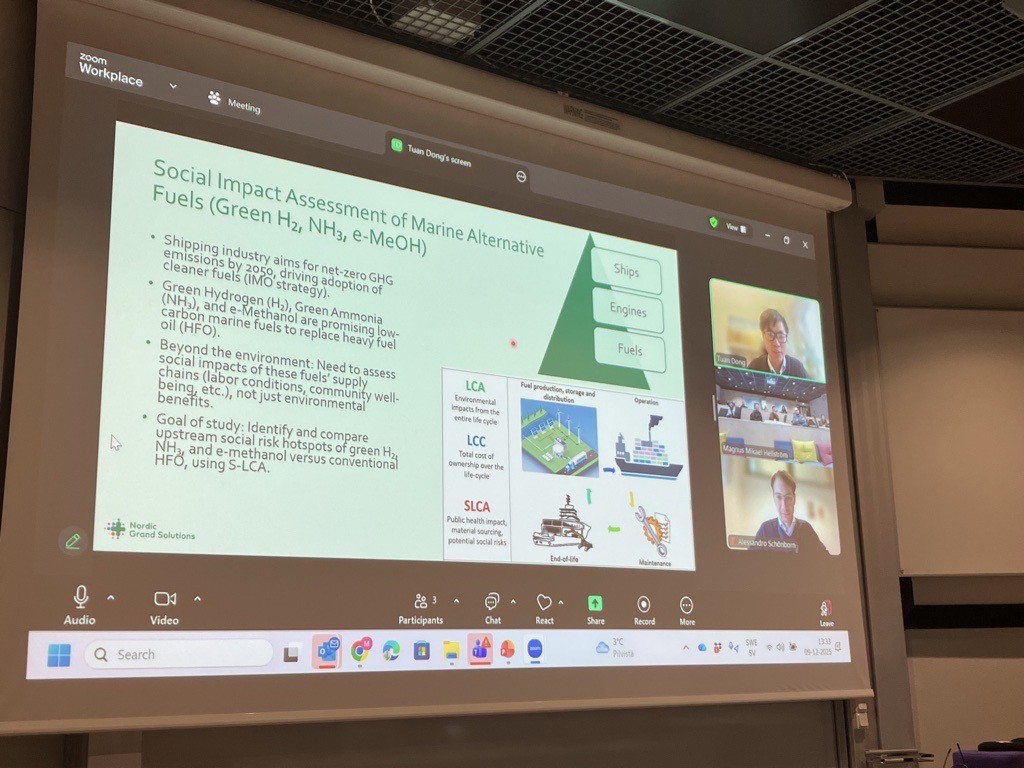
The afternoon sessions highlighted international collaboration through joint activities with the Hi-EFECTS project and the World Maritime University. Researchers Tuan Dong and Alessandro Schönborn presented results focusing on potential social impacts of alternative marine fuels. In this context, Flex-CPT and Hi-EFECTS participants discussed potential social risks associated with electrofuel production, using Social-LCA as an analytical approach. This exchange underlined the importance of considering not only environmental and economic aspects, but also social dimensions when assessing future fuel solutions.