The transition towards cleaner and more sustainable industrial processes requires not only new technologies, but also effective solutions to reduce harmful emissions. Among these, nitrous oxide (N₂O) is a particularly important challenge due to its strong impact on both climate change and the ozone layer. Although present in relatively low concentrations, it is generated in significant amounts across several industrial processes, making its reduction an important goal.
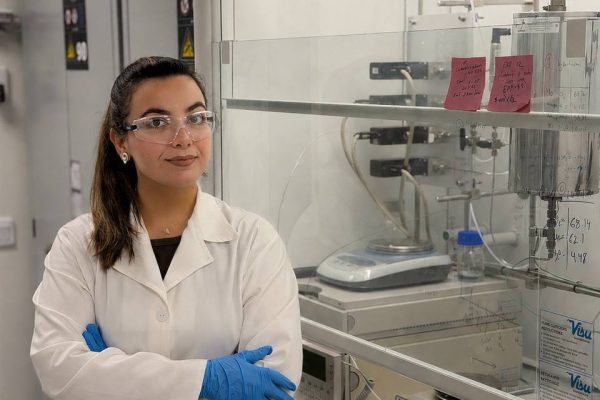
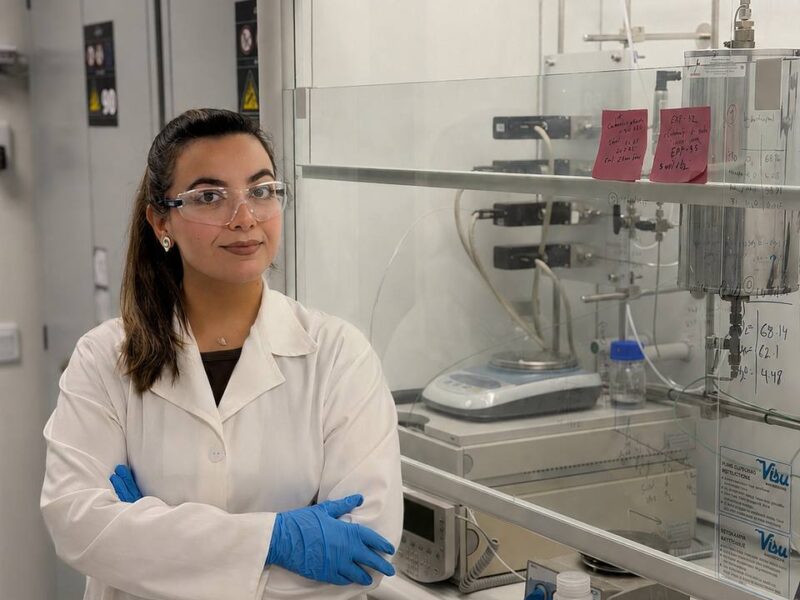
This forms the background for the Master’s thesis of Ghazal Askari at Åbo Akademi University, where she investigates the decomposition of nitrous oxide using copper-modified zeolite catalysts. Her work focuses on understanding how different catalyst structures behave under realistic conditions, particularly in the presence of oxygen and under hydrothermal environments. The thesis was carried out at Åbo Akademi University under the supervision of Professor Dmitry Yu. Murzin, together with Docent Narendra Kumar, Dr. Kari Eränen, and Dr. Jari Böling.
Ghazal’s research was conducted as part of the Flexible Clean Propulsion Technologies (FLEX-CPT) project, which explores pathways towards cleaner propulsion and energy systems. By addressing the challenge of nitrous oxide emissions, her work contributes to the broader goal of developing more sustainable and efficient technologies.
Ghazal Askari recently completed her Master’s degree in Sustainable Chemical and Process Engineering at Åbo Akademi University. Her master’s research focused on catalytic approaches for reducing nitrous oxide (N₂O) emissions, with a particular emphasis on copper-modified zeolite catalysts. The work was carried out within the FLEX-CPT project, which aims to support the development of cleaner and more sustainable propulsion and energy technologies.
“My master’s thesis gave me a strong foundation in catalyst synthesis, characterization, and reaction engineering” Ghazal says.
At the core of her thesis lies a practical question: how can nitrous oxide emissions be effectively reduced under realistic industrial conditions? The main focus of the research was to find an effective way to reduce nitrous oxide emissions by studying the direct decomposition of nitrous oxide into environmentally harmless nitrogen and oxygen without requiring additional reducing chemicals such as ammonia or hydrocarbons. To make this reaction possible at lower temperatures, Ghazal prepared and tested copper-modified HZSM-5, SAPO-34, and SAPO-41 zeolite catalysts. She compared their performance and investigated how oxygen and water vapor affect their activity and stability under conditions that are closer to real industrial exhaust streams.
Her research links directly to key themes within FLEX-CPT, particularly those related to emission reduction, catalytic processes, and sustainable energy systems. More specifically, the thesis contributes to WP4 by investigating the direct catalytic decomposition of nitrous oxide using copper-modified HZSM-5, SAPO-34, and SAPO-41 zeolite catalysts. The work examines how catalyst structure, copper loading, oxygen concentration, and hydrothermal conditions influence catalytic activity and stability under conditions relevant to real exhaust-gas streams.
One of the key findings of the thesis is the difference in performance between the studied catalysts. The results showed that the structure of the catalyst and the accessibility of the copper active sites are more important than simply increasing the amount of copper. Among the catalysts studied, Cu-modified HZSM-5 with a moderate copper loading showed the highest activity, reaching almost complete N₂O conversion at 400–500 °C and clearly outperforming the SAPO-34 and SAPO-41 catalysts.

a. N₂O conversion (%) and (b) turnover frequency (TOF, min⁻¹) as a function of reaction temperature over the Cu(Nitrate)–HZSM-5-50-EIM (1.78 g) catalyst under different feed conditions: 5, 10, and 15 vol% H₂O, and 10 vol% O₂
The study also showed that oxygen mainly inhibits the reaction through a kinetic effect caused by the accumulation of oxygen species on the active sites, rather than by permanently damaging the catalyst structure. In addition, the Cu-HZSM-5 catalyst showed encouraging hydrothermal stability, while the results overall demonstrate that Cu-HZSM-5 is a promising non-noble-metal catalyst for N₂O removal under conditions closer to real exhaust environments.
To support these findings, the thesis combined catalyst preparation, characterization, and experimental evaluation under relevant conditions. The work investigated how different factors influence catalytic performance and examined how stable the materials remain when exposed to oxygen-rich and steam-containing conditions.
One of the main scientific challenges was understanding why catalytic activity decreased under certain conditions and distinguishing temporary reaction inhibition from permanent structural damage to the catalyst. By combining catalytic experiments with several characterization techniques and examining the catalysts before and after exposure to oxygen- and steam-containing conditions, Ghazal connected catalytic performance with changes in copper dispersion, particle size, pore structure, and zeolite stability. This showed that oxygen inhibition was mainly kinetic rather than the result of irreversible structural degradation. Another challenge was understanding why the Cu-SAPO catalysts showed unexpectedly low N₂O conversion despite their suitable structural and physicochemical properties.
Beyond the individual results, the study provides insights into how catalyst design and operating conditions interact. The results can help guide the design of more durable and efficient non-noble-metal catalysts for N₂O emission control, particularly for exhaust streams containing oxygen and water vapor. The study also shows that controlling the zeolite framework, copper loading, dispersion, and accessibility of the active sites is essential for achieving both high activity and long-term stability. For future research, the work suggests optimizing copper loading further, investigating additional zeolite structures, and testing catalysts under even more realistic exhaust conditions containing components such as NO, NO₂, and residual NH₃. Longer time-on-stream and regeneration studies would also be important before moving toward practical industrial application.
Now that the thesis is complete, Ghazal is looking ahead to the next stage of her research career.
“I plan to continue my studies and research with Professor Dmitry Yu. Murzin at Åbo Akademi University. I would like to further develop my research experience and continue working on topics related to catalysis and sustainable chemical processes. My master’s thesis gave me a strong foundation in catalyst synthesis, characterization, and reaction engineering, and I am looking forward to building on this experience in my future research.”
Through this combination of experimental work and applied analysis, Ghazal Askari’s thesis contributes to the FLEX-CPT project by addressing a relevant environmental challenge. It demonstrates how a deeper understanding of catalytic systems can support the development of more sustainable solutions for emission control.